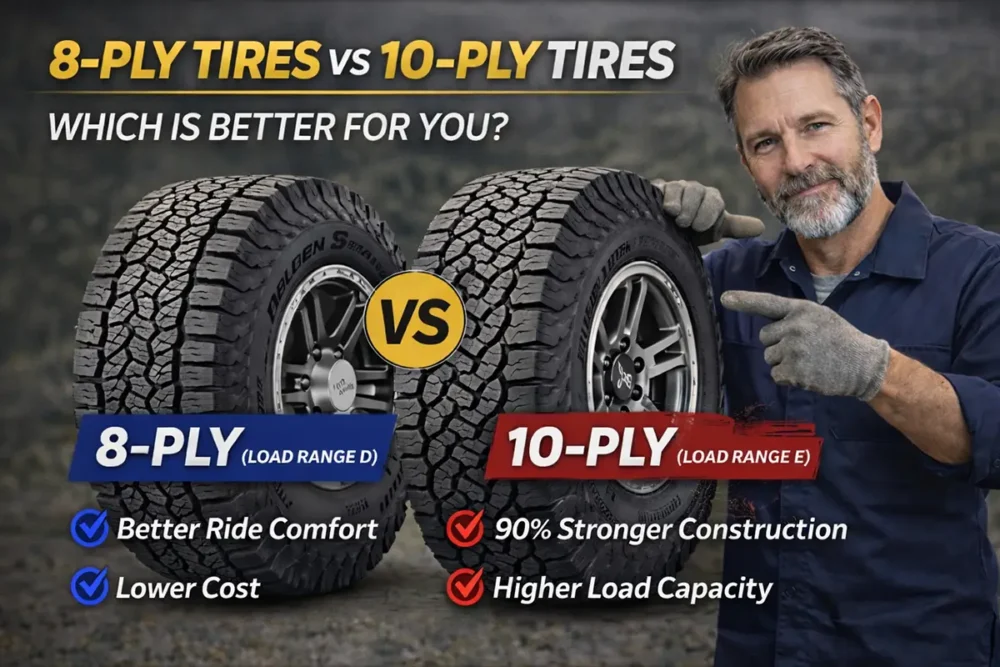
If you’ve ever stood in a tire shop staring at a spec sheet, wondering whether an “8 ply” or “10 ply” tire ply rating actually matters for your truck, you’re not alone. I’ve had that exact conversation more times than I can count — and honestly, the confusion makes sense.
The terminology is outdated, the marketing is misleading, and nobody seems to explain what these numbers actually mean in the real world.
I’ve put over 10,000 miles on both Load Range D (8 ply rated) and Load Range E (10 ply rated) tires across Ford F-150, Toyota Tacoma, and Ram 1500 — through highway hauls, muddy trails, and loaded-up towing runs.
I’ve felt the difference firsthand, and I want to give you the clearest picture possible.
Before you make a decision, I’d highly recommend bookmarking my complete tire buying and maintenance guide — it covers everything from reading tire sidewalls to maximizing tread life. Now, let’s get into the 8 ply vs 10 ply debate.
⚡ TL;DR
- 8 ply tires (Load Range D): Max load ~2,205 lbs per tire. Best for light hauling, daily driving, mild off-road, and half-ton trucks not regularly towing.
- 10 ply tires (Load Range E): Max load ~3,042 lbs per tire. Best for heavy towing, payload hauling, commercial use, and trucks regularly working near capacity.
- Key trade-off: 10 ply tires give you more strength and durability but deliver a stiffer, noisier ride with slightly worse fuel economy.
- Choose 8 ply if: You’re a daily driver or occasional hauler who values ride comfort.
- Choose 10 ply if: You regularly tow heavy loads, haul near payload capacity, or run a commercial vehicle.
- What Does Ply Rating Actually Mean?
- 8 Ply Tires Explained (Load Range D)
- 10 Ply Tires Explained (Load Range E)
- 8 Ply vs 10 Ply Tires: Key Differences
- Detailed Comparison: 8 Ply vs 10 Ply
- When Should You Choose 8 Ply Tires?
- When Should You Choose 10 Ply Tires?
- Can You Switch Between 8 Ply and 10 Ply?
- Common Mistakes Buyers Make
- Real-World Scenarios: Which Tire Rating Fits Your Life?
- Final Verdict: 8 Ply vs 10 Ply Tires
- Related Tire Ply Comparisons
What Does Ply Rating Actually Mean?
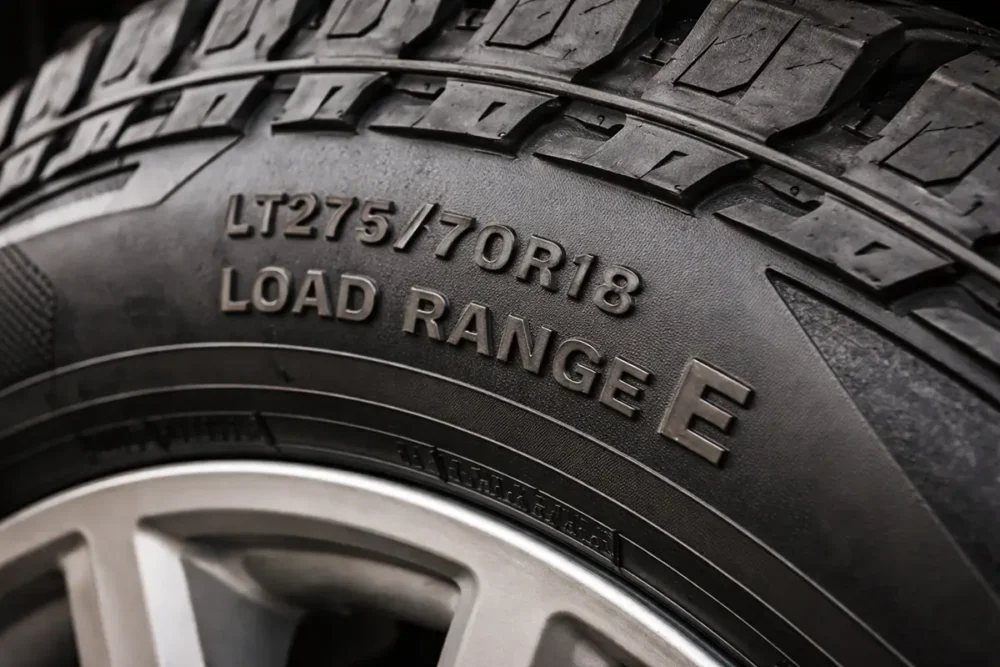
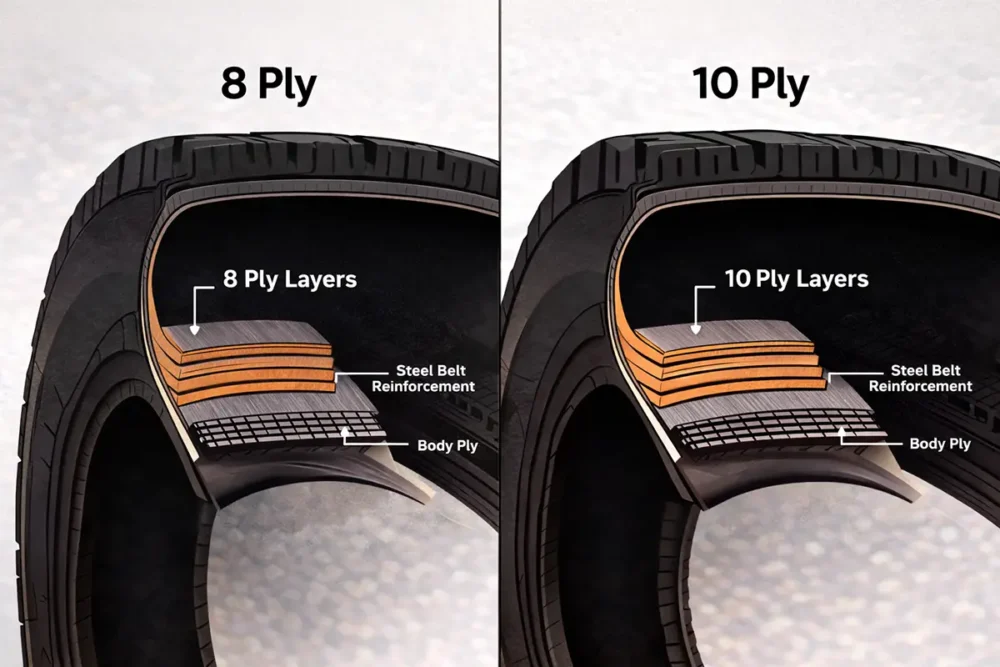
Here’s where most buyers get tripped up. The term “ply” originally referred to the number of physical rubber-coated fabric layers inside the tire. A 10-ply tire literally had 10 layers. That was the 1940s.
Today, modern tires use advanced synthetic materials — polyester, steel, and aramid — that are far stronger per layer.
So a modern “10 ply rated” tire might only have 2–4 actual physical plies, but it’s engineered to handle the same load as an old-school 10-layer tire.
The terms you actually need to understand are Load Range and Load Index:
- Load Range D = 8 ply rating. These tires are designed for a maximum inflation pressure of 65 PSI and carry loads up to roughly 2,205 lbs per tire.
- Load Range E = 10 ply rating. Designed for up to 80 PSI and loads up to approximately 3,042 lbs per tire.
So when someone says ‘8 ply vs 10 ply,’ they’re really comparing Load Range D vs Load Range E tires. Keep that in mind throughout this guide.
8 Ply Tires Explained (Load Range D)
My Experience with 8 Ply Tires
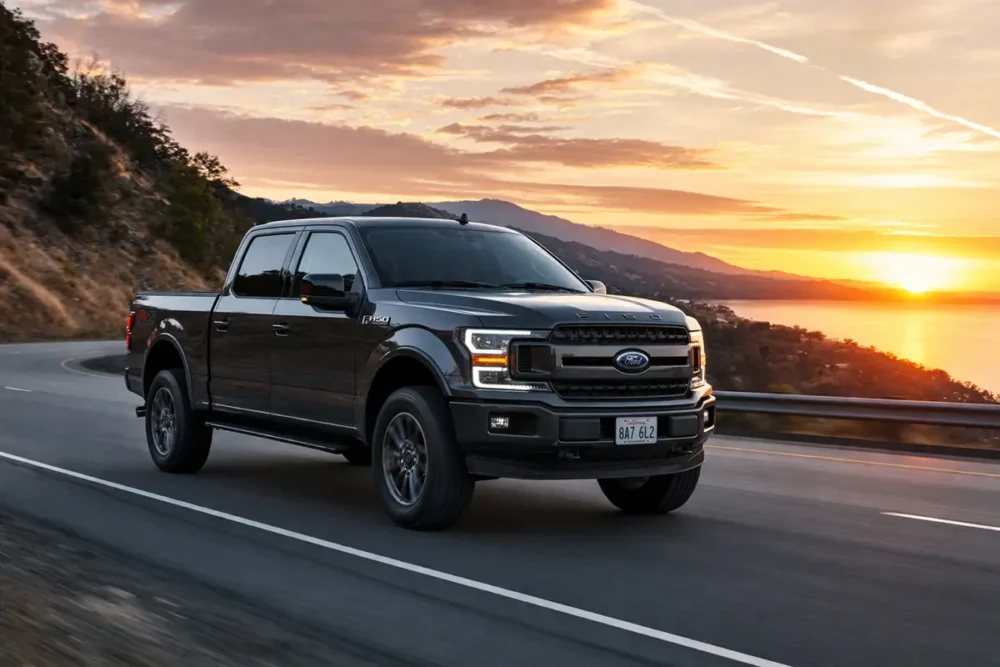
I ran Load Range D tires on my Ford F-150 for about 18 months across a mix of highway commuting, light gravel trail work, and occasional light hauling — mulch loads, camping gear, that kind of thing.
The ride quality was noticeably more comfortable compared to any Load Range E setup I’ve tested. On the highway, road noise was manageable. The steering felt responsive, and fuel economy stayed consistent around 17–18 MPG on the highway.
Where I noticed the limitation was towing my 5,500-pound utility trailer on a long mountain route. The sidewalls felt squishier under load, the truck needed more braking distance, and I started to feel that familiar nervousness that comes with pushing a tire near its comfort zone.
It wasn’t dangerous — I wasn’t over the rating — but the feedback from the tire wasn’t as planted as I wanted.
8 Ply Tire Pros
- Noticeably smoother, more comfortable ride quality
- Better fuel economy compared to 10 ply equivalents
- Quieter on pavement — great for daily commuting
- Lighter weight, which benefits payload capacity math slightly
- Lower purchase price in most cases
8 Ply Tire Cons
- Lower load-carrying ceiling — not ideal for heavy towing
- Thinner sidewalls more prone to punctures and cuts
- Less stable under maximum payload loads
- Can feel squirmy on deep gravel at high inflation pressures
Best Use Cases for 8 Ply Tires
- Daily drivers using a half-ton truck as a commuter
- Light off-roaders on maintained trails
- Occasional haulers who rarely hit payload limits
- Towing trailers under 6,000 lbs
10 Ply Tires Explained (Load Range E)
My Experience with 10 Ply Tires
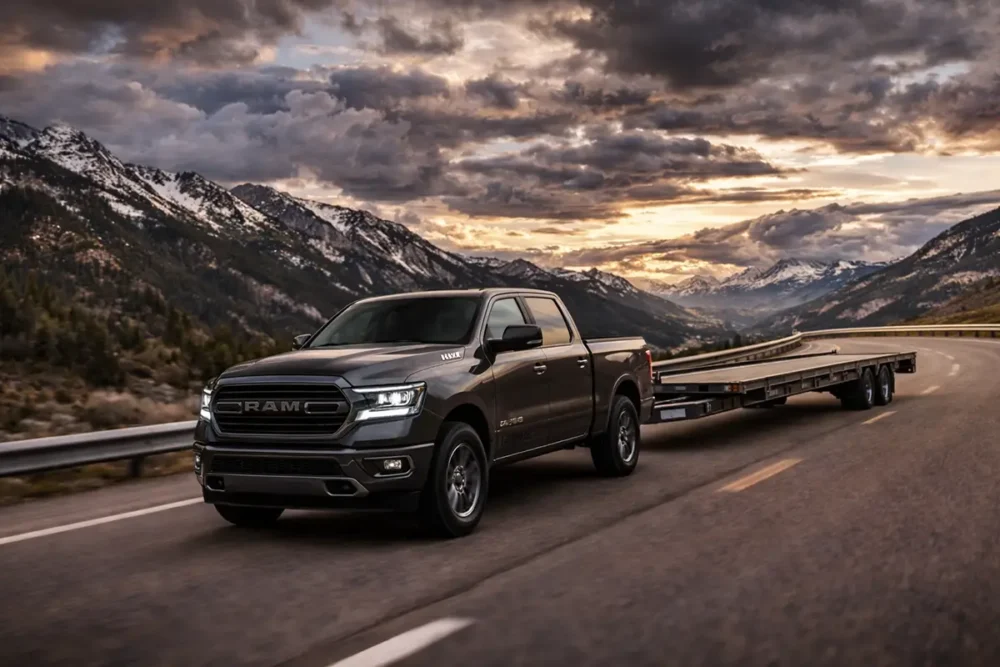
I switched to Load Range E tires on the same F-150 for a work period where I was regularly towing my 8,500-pound flatbed trailer. The difference was immediately obvious — not just in load confidence, but in how the entire truck behaved under weight.
Braking was firmer. Sway was reduced. The sidewalls held their shape even when the trailer pushed hard on a downhill grade.
Off-road, the stiffer sidewalls made airing down less effective for flotation on sand (you need to drop more PSI to get the same contact patch), but the resistance to punctures on rocky terrain was clearly superior.
I got through a rocky canyon trail with zero concerns, where previously I’d babied my Load Range D setup carefully.
The trade-off hit me on the daily commute home. My lower back noticed it by week two. The ride was harder, the road imperfections translated more directly into the cab, and fuel economy dropped about 1.5 MPG compared to my Load Range D setup. Not a dealbreaker for a working truck — but real.
10 Ply Tire Pros
- Significantly higher load-carrying capacity
- Stiffer sidewalls resist cuts, punctures, and blowouts better
- Greater stability under full payload and towing conditions
- Better performance on rocky and technical off-road terrain
- More consistent handling when towing at or near capacity
10 Ply Tire Cons
- Stiffer, harsher ride — especially noticeable when not loaded
- Higher road noise on pavement
- Slightly lower fuel economy (typically 1–2 MPG difference)
- More expensive upfront
- Heavier, which adds unsprung weight
Best Use Cases for 10 Ply Tires
- Heavy towing (trailers 7,000 lbs and above)
- Commercial or work trucks regularly hauling near payload limits
- Off-road vehicles tackling rocky, sharp terrain
- Drivers who prioritize durability over comfort
8 Ply vs 10 Ply Tires: Key Differences
| Feature | 8 Ply (Load Range D) | 10 Ply (Load Range E) |
| Max Load Per Tire | ~2,205 lbs | ~3,042 lbs |
| Max PSI | 65 PSI | 80 PSI |
| Ride Quality | Smoother, more comfortable | Stiffer, firmer |
| Towing Suitability | Light to moderate towing | Heavy towing recommended |
| Sidewall Strength | Moderate | High |
| Fuel Economy | Better (fewer rolling losses) | Slightly lower (~1–2 MPG) |
| Road Noise | Quieter | Noisier on pavement |
| Off-Road Puncture Resistance | Moderate | Excellent |
| Tread Life | Good | Very Good (stiffer compounds) |
| Price | Typically lower | Typically higher |
Detailed Comparison: 8 Ply vs 10 Ply
Ride Comfort
This is the category where 8 ply tires win decisively, and it’s not close. Load Range D tires flex more through their sidewalls, which means they absorb road imperfections before those vibrations transmit to your truck’s suspension and cabin.
If you’re driving an unladen F-150 or Tacoma 80% of the time, the comfort advantage of 8 ply tires is something you’ll feel every single day.
Load Range E tires, by contrast, are engineered to stay rigid under heavy load. That rigidity doesn’t go away when you’re empty. You feel every road seam, expansion joint, and pothole more directly.
Some drivers adapt; others find it genuinely fatiguing on longer highway runs.
Load Carrying Capacity
10 ply tires win this one, and it’s the whole point of the upgrade. A full set of Load Range E tires can carry approximately 12,168 lbs total (4 x 3,042 lbs), versus roughly 8,820 lbs for Load Range D (4 x 2,205 lbs).
That’s a meaningful difference when your truck’s GVWR and payload ratings come into play.
Important note: always cross-check your truck’s GVWR and payload sticker against your tire’s load index. Installing 10 ply tires doesn’t increase your truck’s payload rating — it just means the tires can handle what the truck was already rated for.
Towing & Hauling Performance
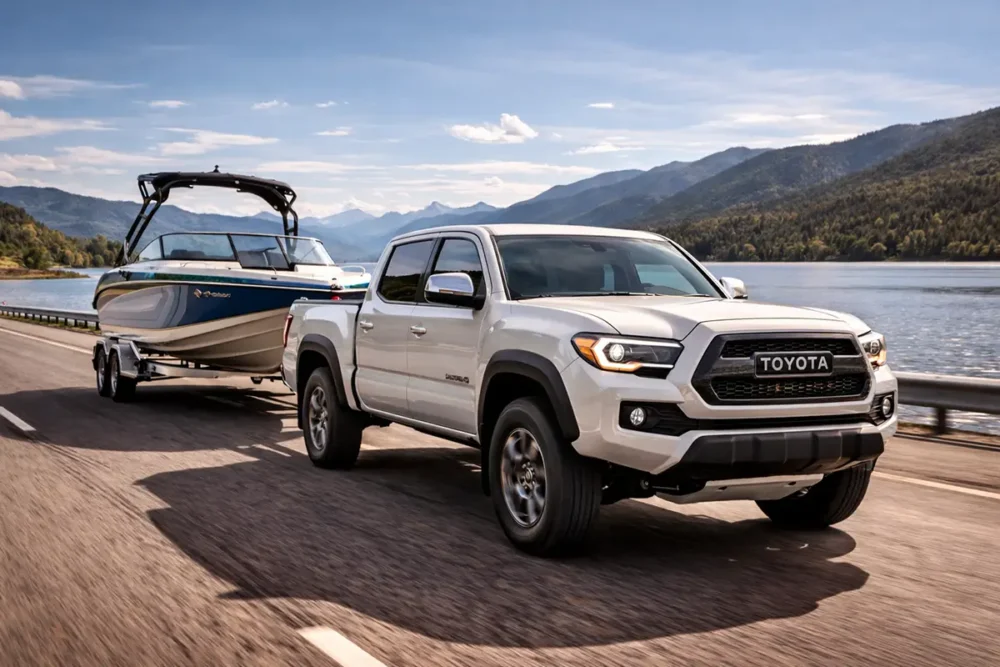
I’ll be direct: if you’re towing over 7,000 lbs with any regularity, 10 ply tires are the right choice. Period.
The stiffer construction keeps the sidewalls from bulging under tongue weight, braking is more predictable, and trailer sway is reduced because the rear axle has a more stable footprint on the pavement.
For lighter towing — boats under 4,000 lbs, small utility trailers, camper shells — 8 ply tires are completely adequate. I’ve towed a small fishing boat for years on Load Range D tires without issue.
Off-Road Capability
Both ratings can handle light to moderate off-road work. The key difference shows up on rocks and sharp terrain. Load Range E tires resist sidewall cuts and punctures meaningfully better.
On a sharp shale trail I’ve tested both on, I had one sidewall puncture on Load Range D tires and zero on Load Range E across similar distances.
That said, 8 ply tires are easier to air down for sand and mud — the more compliant sidewall creates a better contact patch at lower pressures. 10 ply tires need to drop lower PSI to achieve the same effect.
Durability & Sidewall Strength
Load Range E wins clearly. The stiffer sidewall construction is simply more resistant to physical damage, heat buildup, and deformation under load.
For drivers who frequently max out their payload or tow regularly, this durability translates into fewer blowouts and longer tire life overall.
Fuel Efficiency
Load Range D tires typically return 1–2 MPG better than their Load Range E counterparts on the same vehicle. The difference comes from rolling resistance — stiffer compounds and higher inflation pressures increase resistance slightly.
Over 15,000 miles annually, that can be 15–30 additional gallons of fuel per year at average prices. Worth considering for daily drivers.
Noise Levels
8 ply tires are quieter, especially on highway surfaces. The more compliant sidewall dampens tread noise before it reaches the cabin.
Load Range E tires, particularly aggressive all-terrain variants in 10 ply, can produce noticeable drone at highway speeds that some drivers find tiring on long trips.
Tread Life
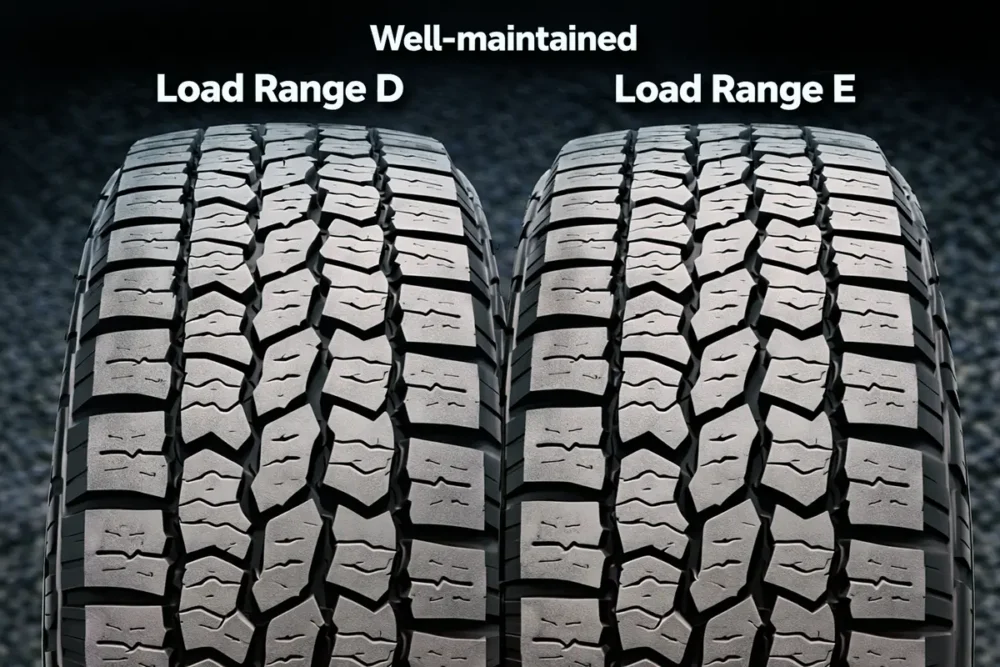
Slightly in favor of 10 ply tires, largely because the stiffer compounds used in Load Range E construction tend to wear more slowly. However, the difference is modest — usually 5,000–10,000 miles in ideal conditions.
Driving behavior, inflation maintenance, and rotation schedules affect tread life far more than ply rating alone.
When Should You Choose 8 Ply Tires?
Choose Load Range D tires if your situation looks like any of these:
- You drive a half-ton truck primarily as a daily driver or family vehicle
- Your towing is occasional and stays under 6,000–7,000 lbs
- Ride comfort and noise levels are priorities for you
- You’re conscious of fuel economy and want to minimize losses
- Your off-road driving is on maintained dirt roads, gravel, or light trails
- You haul occasionally but rarely approach your truck’s payload limit
When Should You Choose 10 Ply Tires?
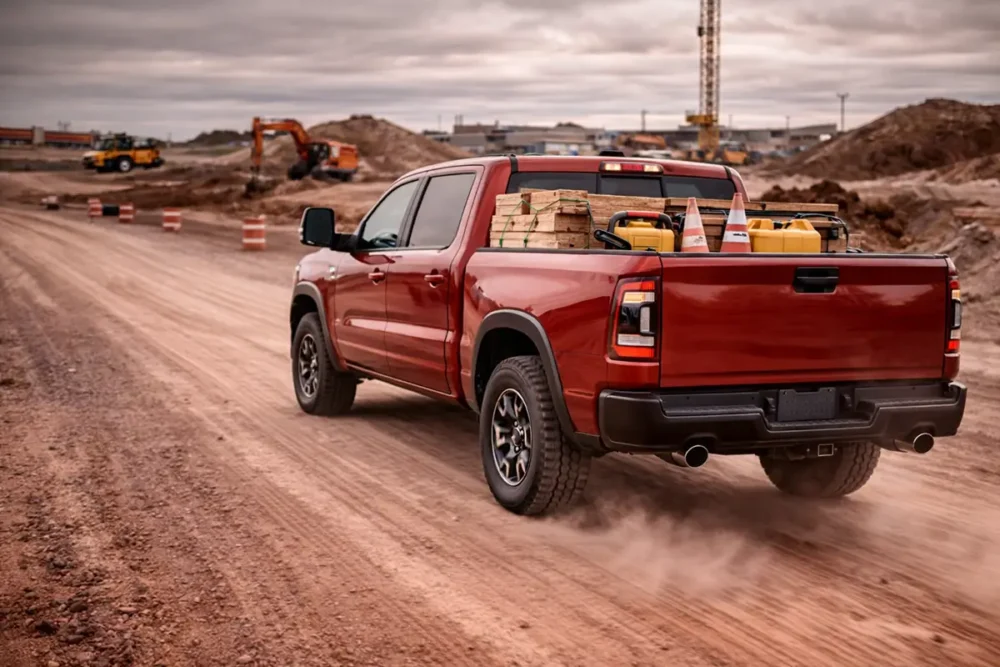
Go with Load Range E tires if your situation matches these criteria:
- You regularly tow trailers over 7,000 lbs
- You use your truck for commercial hauling or work duty
- You’re running a three-quarter ton (3/4T) or one-ton truck near its payload rating
- Your off-road driving involves sharp rocks, technical terrain, or remote areas where a flat is a serious problem
- Durability and load confidence matter more to you than ride comfort
- You’re frequently loaded with bed cargo near your truck’s payload rating
Can You Switch Between 8 Ply and 10 Ply?
Yes — with caveats. Physically, if the tire size is compatible with your wheels, you can mount either rating. But there are important considerations:
- Upgrading from 8 ply to 10 ply: Your truck will have stiffer suspension feel. Make sure the tire’s load index meets or exceeds your vehicle’s GVWR requirements. Higher inflation pressures with 10 ply tires are normal — don’t inflate to the tire’s max; follow your door placard recommendation or adjust for load.
- Downgrading from 10 ply to 8 ply: Only do this if your truck’s payload and towing needs are clearly within Load Range D limits. Check your door placard. Some 3/4-ton and 1-ton trucks require Load Range E tires to meet GVWR requirements — downgrading could be unsafe and void warranty.
- Never mix ply ratings on the same axle. This creates uneven load distribution and handling instability.
Always consult your owner’s manual and the tire placard on the driver’s door jamb before switching load ranges.
Common Mistakes Buyers Make
- Assuming higher ply = always better: 10 ply tires on a lightly used daily driver just make the ride harsher for no real benefit. Match the tire to your actual use case.
- Ignoring the door placard: Your truck’s placard specifies the minimum load range required. Downgrading below it is a safety issue, not just a preference choice.
- Inflating to max PSI: The max PSI on the tire sidewall is the tire’s structural ceiling, not your recommended driving pressure. Use the pressure on your door placard or adjust for your load.
- Confusing ply rating with quality: A well-made 8 ply tire from a reputable brand will outperform a cheap 10 ply tire in almost every real-world metric.
- Not considering how they’re driven unladen: 10 ply tires are primarily designed to perform under load. Empty, they’re harsher than they need to be — and many work truck owners spend more time empty than loaded.
Real-World Scenarios: Which Tire Rating Fits Your Life?
Scenario 1: The Daily Driver/Weekend Explorer
You drive a Ford F-150 XLT to work five days a week. On weekends, you occasionally camp, tow a small pop-up trailer (around 3,500 lbs), and take forest service roads. You value comfort and decent fuel economy.
Verdict: 8 ply (Load Range D). You’re nowhere near the limits where 10 ply strength becomes necessary, and you’ll appreciate the quieter, smoother daily driving experience.
Scenario 2: The Regular Tower
You own a Ram 1500 and tow a 9,000-lb travel trailer three or four times a year. Between trips, the truck is your daily driver with occasional light hauling.
Verdict: 10 ply (Load Range E). At 9,000 lbs of tow load, you need the stiffer sidewall and higher load capacity. The daily ride trade-off is worth the safety and stability gain when loaded.
Scenario 3: The Off-Road Enthusiast
Your Tacoma TRD Pro spends most weekends on trails. You air down for sand and mud but also tackle rocky terrain. You don’t tow anything heavier than a small sled trailer.
Verdict: Depends on terrain. For mostly dirt/gravel/sand: 8 ply for better air-down compliance. For rocky, technical trails: 10 ply for puncture resistance.
Many off-roaders in this camp opt for 10 ply all-terrain tires specifically because a sidewall failure in the backcountry is a much bigger problem than a slightly stiffer daily ride.
Scenario 4: The Work Truck Operator
Your F-250 hauls equipment daily. You regularly approach or hit the truck’s payload rating with tools, materials, or machinery. Towing is frequent at 10,000+ lbs.
Verdict: 10 ply (Load Range E) without question. At this use level, anything less is a safety compromise, and the durability of Load Range E tires will genuinely extend the interval between replacements in heavy-use conditions.
Final Verdict: 8 Ply vs 10 Ply Tires
After years of driving on both, here’s the honest summary: neither rating is universally better. They’re tools engineered for different jobs.
If your truck is primarily a daily driver with occasional light duty, 8 ply tires will make your life more comfortable without any meaningful safety compromise. You’ll spend less, drive quieter, and keep more fuel in the tank.
If your truck is a working vehicle — regularly towing heavy loads, hauling near payload limits, or tackling terrain where a tire failure creates a serious problem — 10 ply tires are the right call.
The stiffer ride is a trade-off worth making for the confidence and safety margin they provide.
The biggest mistake I see is people buying 10 ply tires because they think “more is always better,” then complaining about the ride quality every day on a truck that never gets used at load.
Match the tire to your actual life, not your theoretical maximum use case.
Related Tire Ply Comparisons
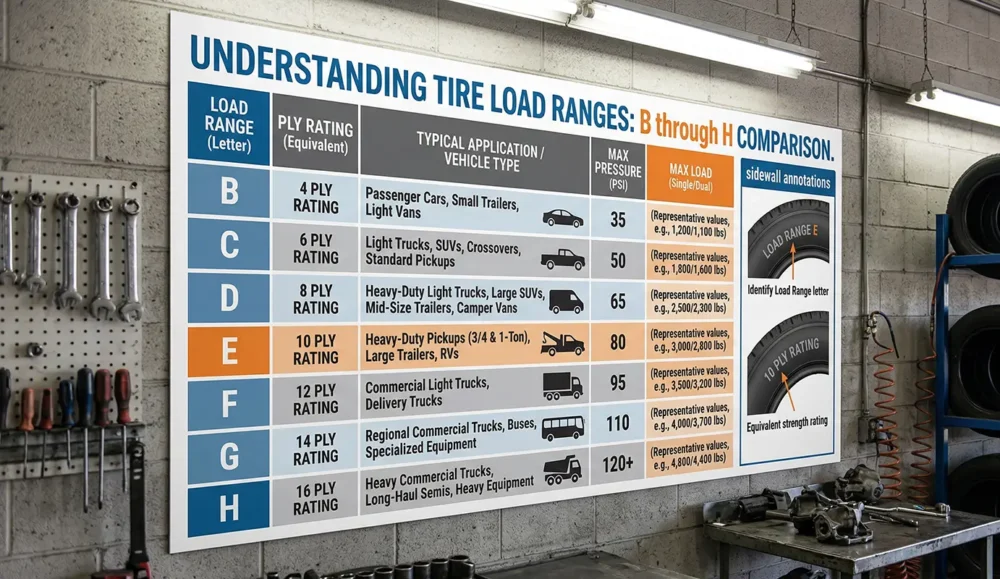
Choosing between load ranges is a nuanced decision, and it doesn’t stop at 8 vs 10 ply. Here are related comparisons worth reading before you finalize your decision:
- 2 Ply vs 4 Ply Tires — You’re reading the definitive guide. Share it with anyone who’s confused about which rating to choose for their passenger car or compact SUV.
- 4 Ply vs 6 Ply Tires — If 4 ply isn’t quite enough for your needs, this comparison helps you decide whether 6 ply is the right next step.
- 4 Ply vs 10 Ply Tires — A major jump in construction strength. Essential reading if you’re considering a heavy-duty upgrade for your truck.
- 6 Ply vs 8 Ply Tires — The next step up from this guide. Great for drivers who need more than 6 ply but want to understand the trade-offs before going full heavy-duty.
- 6 Ply vs 10 Ply Tires — Comparing C-range tires against Load Range E. This covers the big gap between work-truck tires and heavy-duty haulers.
- 8 Ply vs 10 Ply Tires — For drivers running heavy trucks who want to understand the difference between Load Range D and E tires.
- 10 Ply vs 12 Ply Tires — The upper end of the ply spectrum, covering commercial and heavy-duty truck applications.
- 12 Ply vs 14 Ply Tires — Takes you into commercial and industrial territory — heavy trucks and equipment haulers.
- 14 Ply vs 16 Ply Tires — Reserved for heavy commercial vehicles and specialized applications. Great background reading.
- Radial vs. Bias Ply Tire — Understanding the fundamental tire construction types will deepen your knowledge of how ply ratings apply to different tire architectures.
- Load Range C vs D vs E – A comprehensive breakdown of all three common truck tire ratings and which vehicles they’re designed for.
- LT vs P-Metric Tires – Why the tire designation (LT vs P) matters as much as the load range when choosing truck tires.
- Load Range E vs F Tires – Relevant for 1-ton truck and diesel owners exploring whether Load Range F is worth the premium.
Frequently Asked Questions (FAQs): 8-Ply vs. 10-Ply Tires
1. What is the main difference between 8-ply and 10-ply tires?
The primary difference lies in their load-carrying capacity and construction. A 10-ply tire (often equivalent to a Load Range E) has a thicker, stiffer construction designed to handle heavier payloads and towing. An 8-ply tire (Load Range D) is slightly lighter and more flexible, making it a middle ground between standard passenger tires and heavy-duty truck tires.
2. Do I need 10-ply tires for towing a travel trailer or boat?
If you are towing a heavy travel trailer, fifth wheel, or large boat, 10-ply tires are generally recommended. Their stiffer sidewalls significantly reduce “trailer sway” and provide much better stability and safety when your vehicle is under a heavy load. For lighter, smaller trailers, an 8-ply tire may be perfectly sufficient.
3. Will upgrading to 10-ply tires hurt my gas mileage?
Yes, it likely will. Because 10-ply tires are heavier and feature stiffer sidewalls that increase rolling resistance, they require more energy to move. You can typically expect a slight drop in fuel efficiency (around 2-5%) compared to running lighter 8-ply tires.
4. Which tire provides a better ride on the highway?
An 8-ply tire will give you a smoother, more comfortable ride on paved roads. The rigid sidewalls that give 10-ply tires their towing strength also cause them to absorb fewer bumps, leading to a firmer and sometimes harsher ride when driving unloaded.
5. Are 10-ply tires better for off-roading?
For serious off-roading—especially rock crawling or driving through areas with sharp debris—10-ply tires are the preferred choice. The thicker sidewalls offer superior puncture resistance against rocks and branches. However, in soft sand or deep mud where you need the tire to flex and “float” over the surface, an 8-ply tire might perform better when “aired down” due to its flexibility.
6. Do modern tires actually have 8 or 10 layers of material?
Usually, no. Today, “ply rating” is mostly a legacy term used to describe the tire’s overall strength rather than the literal number of fabric layers inside it. Modern tire technology uses fewer, stronger layers (like steel belts). Today, an 8-ply rating is generally referred to as Load Range D, while a 10-ply rating is Load Range E.
7. Should I put 10-ply tires on a light SUV or half-ton truck?
Unless you are using that specific vehicle for heavy hauling, frequent towing, or aggressive off-roading, putting 10-ply tires on a lighter SUV or half-ton truck (like an F-150 or Chevy 1500) is usually overkill. It will result in a stiff ride and worse fuel economy without providing benefits you will actually use. An 8-ply tire or standard passenger (P-metric) tire is usually a better fit for daily driving.